
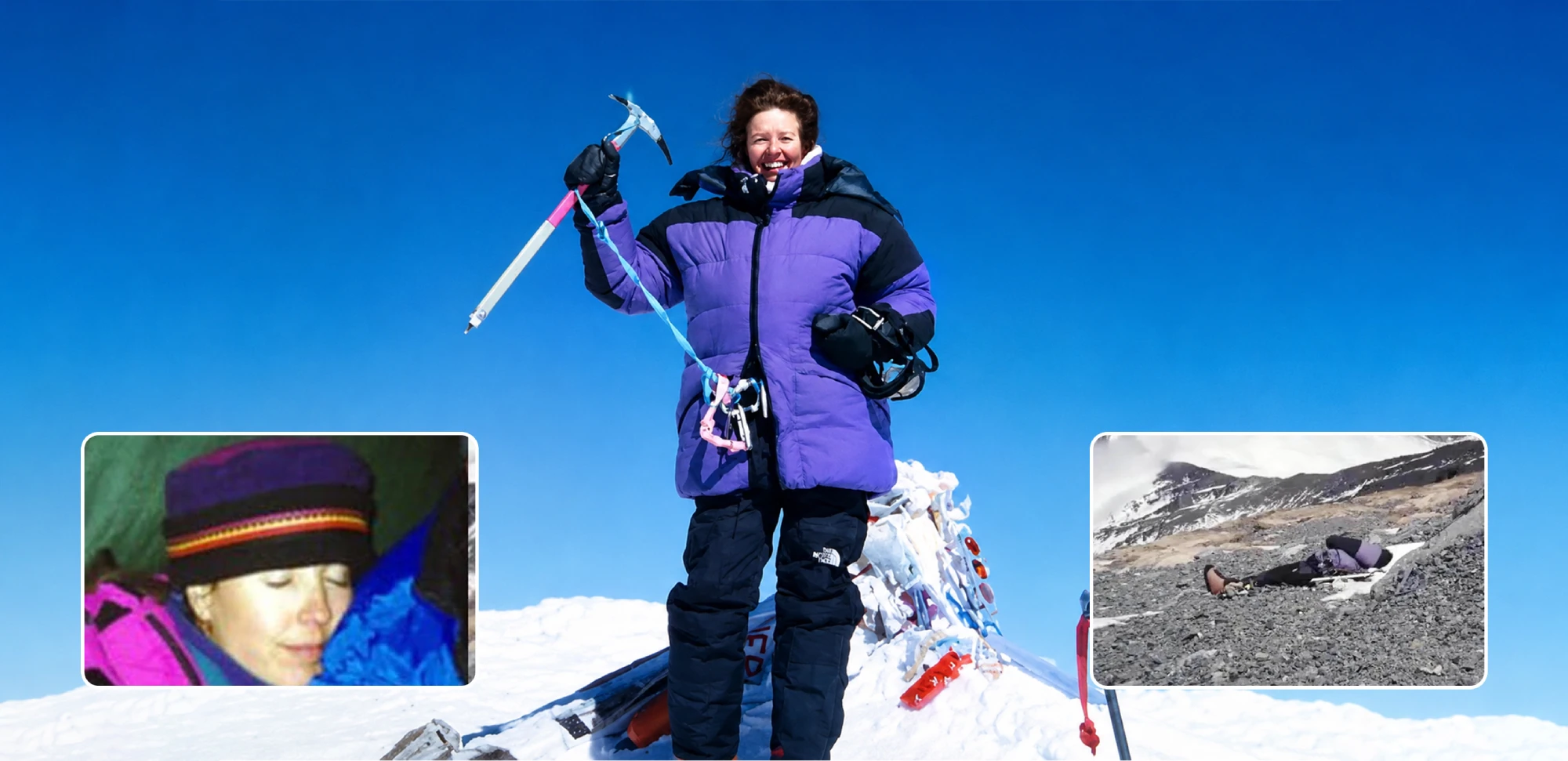
Mount Everest (8848.86 m), the top of the world, is a dream for global mountain adventurers. Reaching the top explains the story of courage, determination, and human endurance. But Everest does not just have a story of successful summits, as the mountain also shares tragic and emotional stories. Among them, the story of American woman Francys Arsentiev is one of the tragic stories recorded in Everest history.
Francys Arsentievs was the first American woman to summit Mount Everest without using supplemental oxygen on May 22, 1998. However, her unsuccessful descent from the summit turned the story into a tragedy. The first American woman to reach the summit without supplemental oxygen paid the devastating cost of summit success with life and reminds climbers that reaching the summit is only half a challenge.
But how did Francys Arsentievs lose her life during descent, and why is she known as a sleeping beauty? In this blog, we explain the Everest incident of May 1998 that took the lives of brave American women during descent. The reason for Francys Arsentiev being known as the Sleeping Beauty of Mount Everest and the efforts made to recover her body are also explained.
Who Was Francys Arsentiev?
|
Information |
Details |
|
Full Name |
Francys Yarbro Arsentiev |
|
Nationality |
American |
|
Born |
January 18, 1958, Honolulu, Hawaii, U.S. |
|
Died |
May 24, 1998 at age of 40, Mount Everest (North ridge) |
|
Cause of Death |
Severe hypothermia, frostbite, and hypoxia (lack of oxygen) |
|
Spouse |
Sergei Arsentiev |
|
Profession |
Mountaineer |
|
Famous For |
First American woman to summit Everest without supplemental oxygen |
|
Summited Everest On |
May 22, 1998 |
|
Climbing route |
|
|
Known as |
Sleeping Beauty Of Everest |
|
Year of Everest Expedition |
1998 |
Francys Arsentiev was the first American woman to summit Everest on May 22, 1998 without supplementary oxygen. She was born on January 18, 1958, in Honolulu, Hawaii, U.S. Arsentiev had an early interest in mountains, and her passion for mountaineering developed further after she got married to legendary Russian climber Sergei Arsentiev in 1992. She climbed several peaks, including Peak Goodwill and Denali, and also became the first US woman to ski down to Mount Elbrus (5,642 m) in south Russia. Later she developed an interest in climbing Everest without supplemental oxygen.
The Historic Everest Expedition of 1998
1. Preparing for the Ultimate Challenge
Following an interest in climbing Everest, Francys Arsentiev and her husband Sergei Arsentiev joined an expedition to climb Mount Everest in 1998. The primary goal for Francys was to climb without supplemental oxygen. Francy’s goal was challenging at elevations above 8,000 m; the available level of oxygen is nearly one-third of sea level. This makes climbing extremely exhausting and difficult. With weeks of acclimatisation and preparation, her expedition begins with Sergei on May 17 1998 where they ascend towards Everest Advance Base Camp (6,400 m) from the North Col.
2. Attempts to Reach the Summit
After ascending to Everest Advance base Camp on May 17 , Francys reached an altitude of 7,700 m while other climbers reached the summit. Their commit attempt continues on May 19 where they reach 8,203 m. On May 20, at 1:00 am, Francys' husband, Sergei, reported that they were fine and were going to start the summit attempt. But the summit attempt was aborted due to headlamp failure. On the next day, May 21, they pushed the second summit attempt where they turned back again to camp after ascending only 50 to 100 m.
3. Becoming the First American Woman to Summit Everest Without Oxygen
After multiple failed attempts, Francys Arsentiev pushed for the summit on May 22 with her husband. In the day, Francys successfully reached the top of Everest without using supplemental oxygen.
The achievement by Francys was extraordinary, as climbing Everest without supplemental oxygen is considered a difficult accomplishment.
4. The Challenges of the Death Zone
The day of May 22 suddenly started turning to disaster for Francys Arsentiev and Sergei Arsentiev. As they both were exhausted and walking dangerously slow, they were late and forced to spend the night above 8,000 m. In the evening, the couple got separated. While Sergei made his way to camp, he managed to carry an oxygen tank and set off to find Francys Arsentiev.
On the day of May 23, the Uzbek team on the final stretch to the summit spotted Francys. Francys was observed to be half conscious and seemed to be affected by frostbite, hypoxia, and Severe hypothermia. As she was unable to move, the Uzbek climbers tried to help her and carried her down further. However, her rescue was not possible, as the death zone challenged climbers with exhaustion and depletion of oxygen. Regarding her husband Sergei, his body was discovered on the lower mountain face later during the 1999 Mallory and Irvine Expedition on Everest.
Why Is She Called the “Sleeping Beauty of Mount Everest”?
On the day of May 24, Ian Woodall, Cathy O'Dowd, and Uzbek climbers encountered Francys Arsentiev on their way to the summit. She was in the same spot where she was left the day before.
While several attempts were made by the mountaineers, including Woodall and O’Dowd, the rescue attempts were not possible. The poor condition of Francy's Arseniev, the challenging location, and the freezing weather forced the rescue operation to abandon. Later, Francys Arsentiev died in the same position, lying on her side while still being clipped in the guide rope.
Later on, as many climbers passed her location, her body seemed like it was peacefully resting despite the tragic incident.
Dressed in a bright purple jacket and red climbing pants, it seems like she is sleeping in the high-altitude landscape. From then, the mountaineers started calling her corpse Sleeping Beauty. Later her body got wide recognition as the Sleeping Beauty of Everest.
Why Climbers Could Not Help Francys Arsentiev
Francys Arsentiev was encountered alive by many climbers at the time, but they could not help her. While several climbers tried for rescue, the extremely dangerous section, the Death Zone, made the rescue impossible.
The rescue operation requires significant effort, oxygen supplies, and technical support, which are not possible at the time. Death zone tests climbers by restricting basic physical movement, and attempting rescue could lead to additional casualties. This made rescuing Francys beyond human capabilities.
Sleeping Beauty: Body Recovery Effort
The body of sleeping beauty, Francys Arsentiev, remained in Everest's northeast ridge for nearly a decade. Her body became the most recognized figure in Everest where many climbers pass by observing the body. In 2007, the recovery effort was attempted by a team of mountaineers. The project was named "Tao of Everest” and led by Ian Woodall.
The goal of the project was to recover her body and move it far from the climbing route. As per the plan, Francys Arsentiev’s body was recovered and was moved to a respected place as a gesture of tribute to the brave American Mountaineer who dared to conquer Everest without supplemental oxygen.
Conclusion
The sleeping beauty of Everest reminds climbers about the challenges and dangers that mountain poses to climbers. It reminds us that a mountain demands both courage and respect. While her achievement as the first American woman to summit Everest without supplemental oxygen marks a history and mountaineering milestone, the cost of delays and the consequence of limited rescue ability are defined. The story of sleeping beauty inspires every mountaineer to be a determined mountaineer who pursues a dream with commitment.
If you are inspired by the journey of Francys Arsentiev and want to experience the challenges of the Himalayas, whether by trekking or peak expedition, contact Mountain Delights Treks & Expedition. Mountain Delights offers professional guides, well-planned itineraries, and memorable journeys where you test your strength, determination, and commitment.





.webp)